
Women AI Leaders
Helping African women lead the AI transition.
Artificial intelligence is reshaping
how work happens across industries.
It is about ensuring that African businesses, institutions and communities benefit from the perspectives, leadership and expertise of women as AI becomes part of everyday work.
From writing and research to design, analysis and decision-making, AI systems are increasingly becoming part of everyday professional workflows.
But technological transitions do more than introduce new tools.
They reshape opportunity — determining who develops the skills, who benefits from the productivity gains and who participates in shaping how these technologies are used.
Ensuring that women are part of the AI transition is therefore not only about representation.
It is about ensuring that African businesses, institutions and communities benefit from the perspectives, leadership and expertise of women as AI becomes part of everyday work.
AI is changing knowledge work.
Artificial intelligence is beginning to influence many forms of knowledge work
— writing, research, coding, communication, data analysis and decision support.
Across organizations, teams are experimenting with AI tools to accelerate tasks that once required much more time.
This shift does not simply automate work.
In many cases, it changes where thinking happens.
When AI systems can generate the first draft of an idea, the human role shifts toward interpretation, judgment and decision-making.
Professionals who understand how to work effectively with these tools will be better positioned to adapt to the changing nature of work.
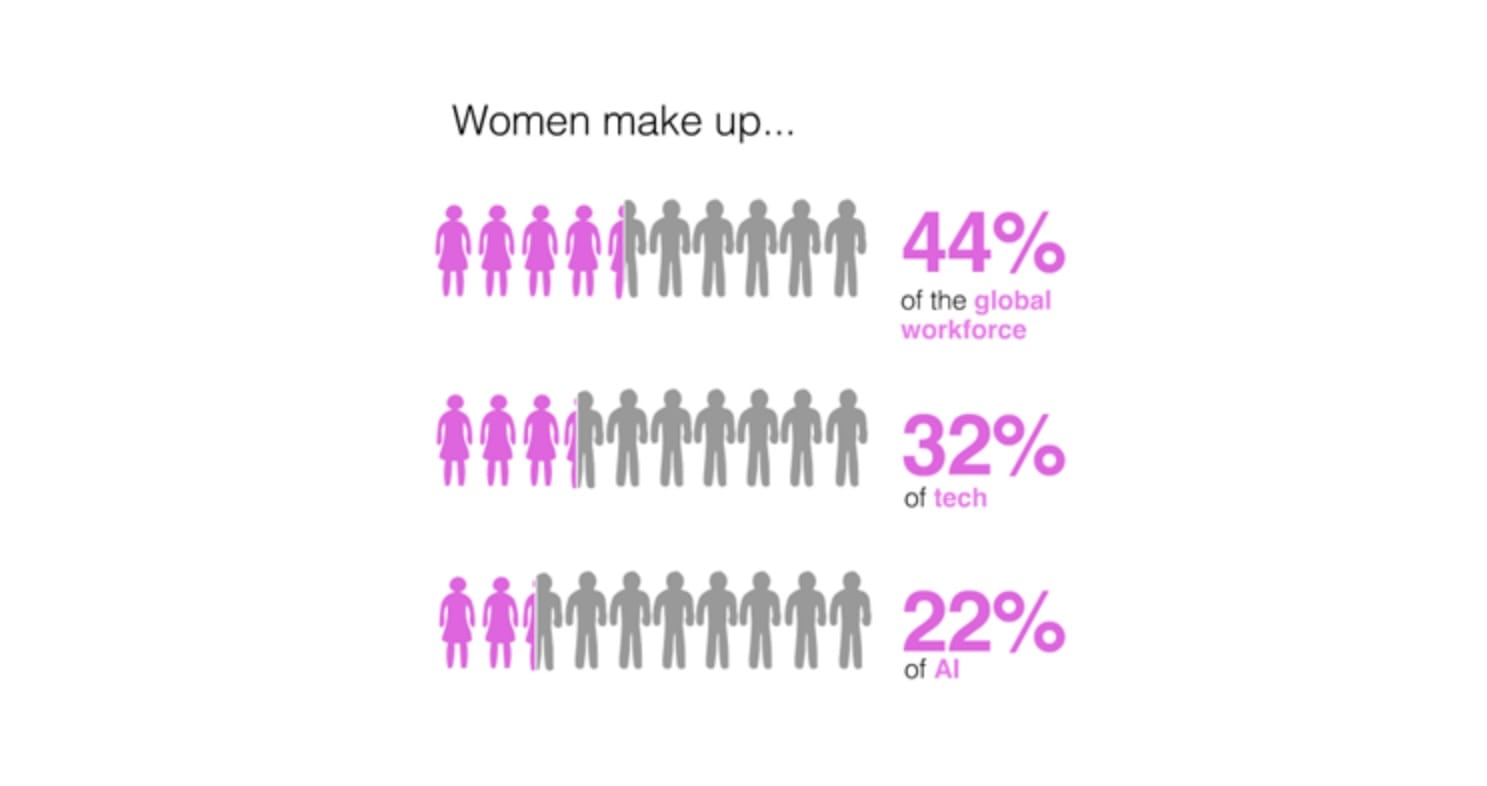
Women are highly exposed to the AI transition
but underrepresented in shaping it.
Artificial intelligence is entering a workforce that is already unevenly structured.
Across many industries, women are more likely to work in roles that involve communication, coordination, documentation and research support.
Many of these tasks are precisely the types of structured knowledge work that generative AI systems are beginning to assist with.
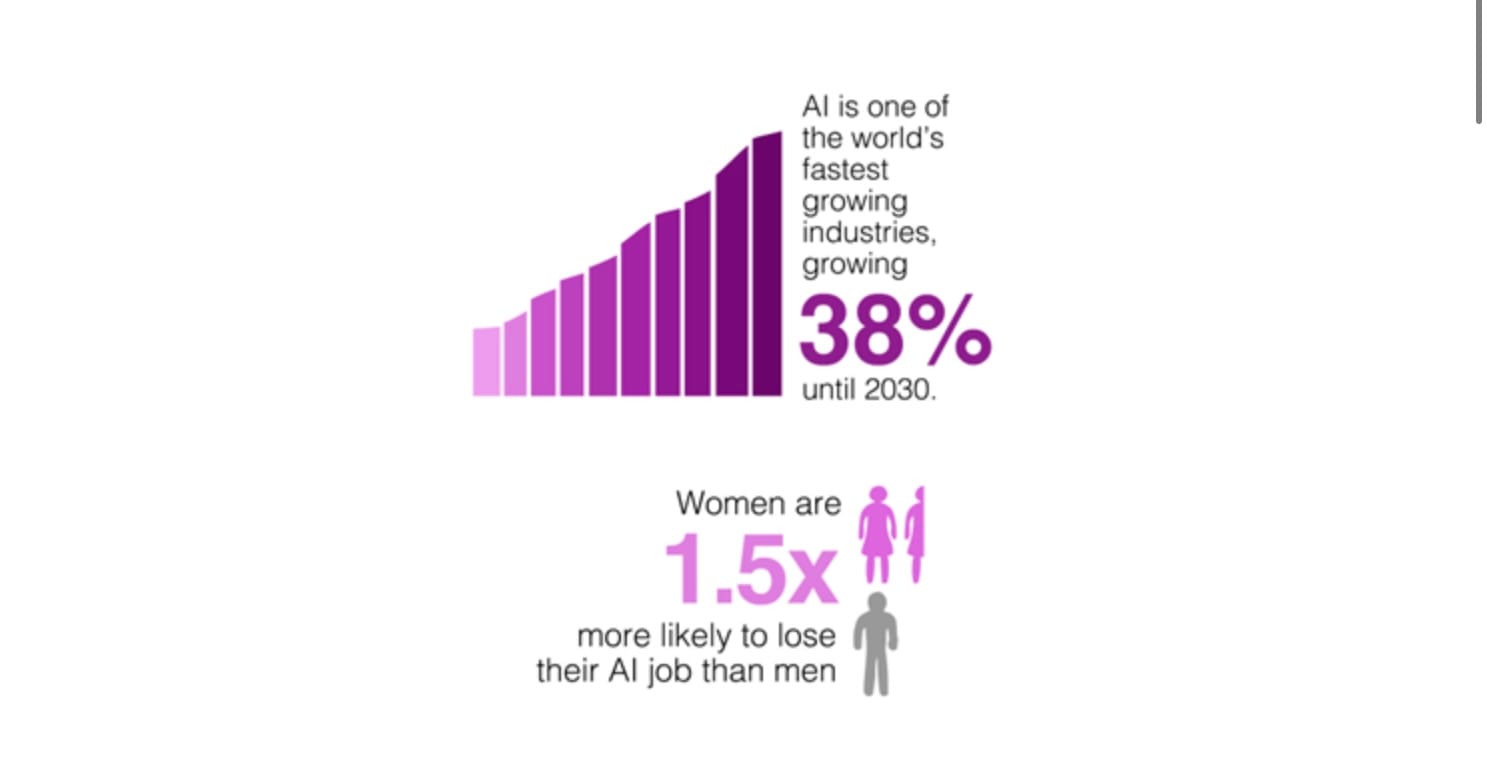
Research from the International Labour Organization shows that occupations dominated by women are significantly more exposed to generative AI technologies than male-dominated ones.
At the same time, women remain underrepresented in the fields that are building and shaping artificial intelligence itself.
Globally, women account for only around 30 percent of the AI workforce.
This creates a structural imbalance: women are highly exposed to the impact of AI, but less represented in shaping how these technologies are designed and deployed.
Key signals
29%
of female-dominated occupations are exposed to generative AI.
16%
of male-dominated occupations face the same exposure.
25%
lower AI adoption rate among women compared to men.
31%
of African women currently use the internet.
Technology & Bias
Technology reflects the societies that create it.
Artificial intelligence systems are trained on large datasets drawn from the real world. These datasets inevitably contain patterns and inequalities that already exist in society.
As a result, AI systems can unintentionally reproduce those patterns.
Researchers studying AI systems across industries have found that many reflect gender bias present in training data. These biases can appear in hiring systems, financial decision tools, healthcare technologies and other systems that increasingly influence real-world opportunities.
Ensuring that women participate in the AI ecosystem helps reduce these risks and contributes to building technologies that better reflect the diversity of the societies they serve.
The African context
Artificial intelligence is projected to contribute up to $1.5 trillion to Africa’s economy by 2030.
Yet participation in the digital economy across the continent remains uneven.
Africa will not experience the AI transition in exactly the same way as Europe or North America. Most professionals work in small and medium-sized businesses, rapidly growing organizations and entrepreneurial ventures where AI adoption looks very different. Building AI literacy therefore requires examples, workflows and learning experiences that reflect African workplaces rather than assumptions from other regions.
Recent data shows that only about 31 percent of African women use the internet, compared to approximately 43 percent of men.
Because internet access is the gateway to digital tools, online education, and technology-driven work, this gap directly affects women’s ability to participate in emerging technologies like AI.
Even when women pursue technical education, barriers remain. Women represent nearly half of STEM graduates in Africa, yet they account for only around a quarter of the technology workforce.
This gap highlights the structural barriers that limit women’s participation in the technology ecosystem.
AI literacy as an entry point.
Participating in the AI transition does not mean becoming a machine learning engineer.
For most professionals, success will come from knowing how to use AI to communicate better, analyze information, make decisions, solve business problems and improve the work they already do.
AI literacy means understanding how these systems generate outputs, where they can be trusted and where human judgment remains essential.
For many women across Africa, AI literacy is one of the most important entry points into the emerging AI economy.
The Women AI Leaders initiative.
Women AI Leaders is an initiative by MNTA that helps African women build practical AI literacy for the workplace.
Our goal is not to teach everyone how to build AI systems. Our goal is to help more women confidently use AI in their careers, businesses and organizations so they can participate in shaping how AI is adopted across Africa.
The program supports:
Professionals who want to use AI confidently in their everyday work.
Entrepreneurs who want to use AI to grow and operate their businesses more effectively.
As AI continues to reshape industries, the goal is not only to help women adapt to technological change, but also to ensure they participate in shaping how these technologies are used.
Ensuring that women across Africa have access to AI literacy, AI training and opportunities in the AI economy is essential for building a more inclusive digital future.
Women AI Leaders was created to support this goal by helping women build practical AI skills and participate in the evolving AI ecosystem.
A moment that will shape the future.
Artificial intelligence is still in the early stages of global adoption.
The systems, institutions and norms surrounding these technologies are still being formed. The choices made today about who has access to skills, tools and participation will influence how artificial intelligence shapes economies and societies in the years ahead.
Ensuring that women across Africa have access to AI literacy, AI training and opportunities in the AI economy is essential for building a more inclusive digital future.
Women AI Leaders was created to support this goal by helping women build practical AI skills and participate in the evolving AI ecosystem.
The Women AI Leaders initiative begins with a practical AI Literacy Sprint designed specifically for African professionals and entrepreneurs.
Through guided lessons and hands-on exercises, participants learn how to use AI confidently in real workplace scenarios.
Whether you’re building your career, leading a team or growing a business, this is your starting point.
References
International Labour Organization (2026). Generative AI and gender equality in the workplace.
Harvard Business School (2025). Women Are Avoiding AI. Will Their Careers Suffer?
UN Women (2024). Artificial Intelligence and Gender Equality.